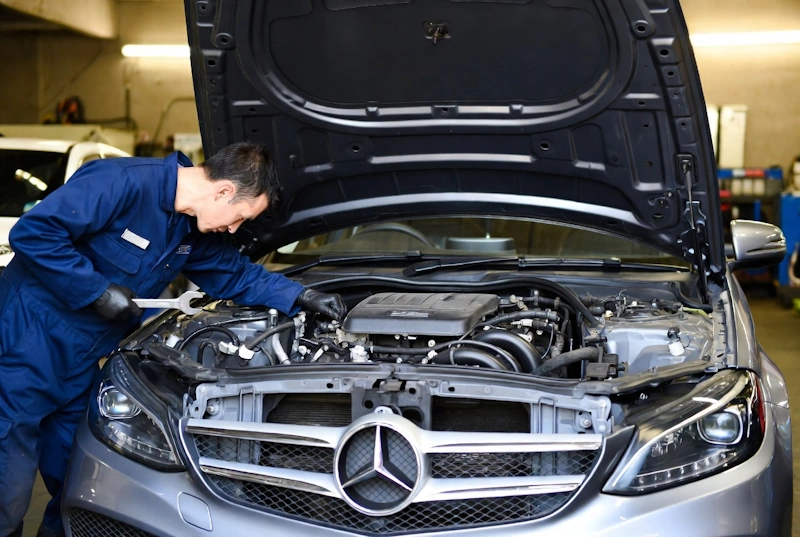
For decades, Mercedes-Benz has offered both gasoline and diesel powertrains across its lineup, leaving many buyers wondering which fuel type better suits their needs. The answer isn’t straightforward—it depends on your driving habits, budget, and what you value most in a vehicle.
Let’s explore how these engines differ, how Mercedes has evolved both technologies, and what makes each option compelling.
How Mercedes gasoline and diesel engines work
At their core, gasoline and diesel engines operate on similar principles—they’re both internal combustion engines that convert fuel into mechanical energy. However, the combustion process differs significantly.
Gasoline engines
Mercedes gasoline engines use spark plugs to ignite a mixture of fuel and air. The engine draws in air, mixes it with gasoline, compresses the mixture, and then ignites it with a precisely timed spark.
Modern Mercedes gasoline engines often feature turbocharging and direct injection, which spray fuel directly into the combustion chamber at high pressure. This allows for better fuel efficiency and more power from smaller displacement engines.
Recent models incorporate mild hybrid systems with 48-volt architecture, adding an electric boost during acceleration and recovering energy during braking.
Diesel engines
Diesel engines in Mercedes, by contrast, rely on compression ignition. They compress air to much higher pressures than gasoline engines, which raises the temperature dramatically.
When diesel fuel is injected into this superheated air, it ignites spontaneously without needing a spark plug.
Mercedes diesel engines have become remarkably sophisticated over the years. The latest generation uses common-rail direct injection with pressures exceeding 2,000 bar, multiple injection events per combustion cycle, and advanced turbocharging systems.
Many also incorporate selective catalytic reduction (SCR) with AdBlue to reduce nitrogen oxide emissions.
Evolution from old to new models
The differences between older and newer Mercedes engines of both types are substantial. If you’re considering a used Mercedes, understanding these generational leaps matters.
Old and modern diesel engines
Older Mercedes diesels from the 1980s and 1990s were known for their legendary durability and that characteristic diesel clatter. Models like the W123 and W124 with their OM616 and OM601 engines could easily surpass 300,000 miles with basic maintenance.
However, they were relatively noisy, produced modest power, and emitted significant particulates and NOx. They also took time to warm up in cold weather and could be sluggish when accelerating.
Modern Mercedes diesels are entirely different machines. The latest OM654 four-cylinder and OM656 six-cylinder engines are smooth, quiet, and powerful.
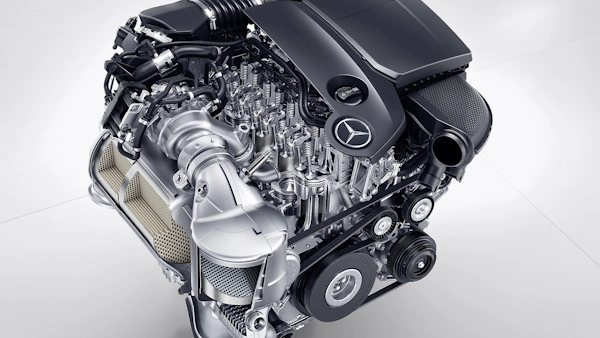
The OM656 inline-six diesel produces up to 286 horsepower and 443 lb-ft of torque in some applications, delivering performance that rivals many gasoline engines while maintaining impressive fuel economy. They use aluminum construction, reducing weight, and incorporate extensive emissions controls including particulate filters and SCR systems.
Old and new gasoline engines
Older Mercedes gasoline engines were typically naturally aspirated and known for smooth, linear power delivery. The M104 inline-six from the 1990s and early 2000s remains beloved for its silky operation and reliability.
However, these engines consumed more fuel than their diesel counterparts and offered less torque at lower RPMs.
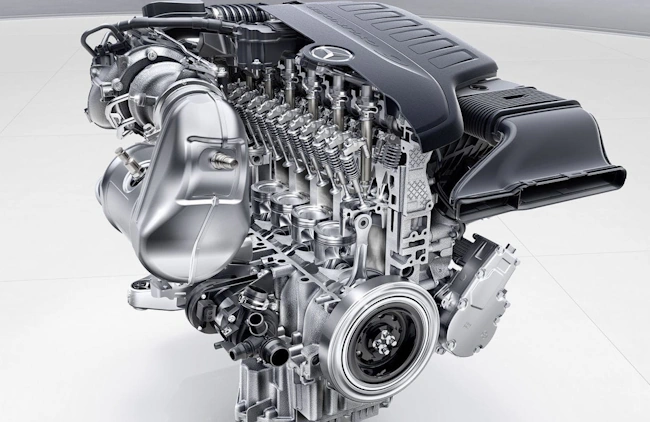
Today’s Mercedes gasoline engines have embraced turbocharging and downsizing.
The M256 inline-six engine combines a twin-scroll turbocharger with an electric supercharger and 48-volt mild hybrid system, eliminating turbo lag while delivering 362-429 horsepower depending on the application.
Four-cylinder engines like the M264 offer surprising power from just 2.0 liters while achieving respectable fuel economy. These modern gasoline engines run on regular or premium fuel depending on the model and feature cylinder deactivation and other efficiency technologies.
Performance and driving experience
The driving characteristics of gasoline and diesel Mercedes differ in ways that matter for daily use.
Diesel
Diesel Mercedes excel at low-end torque. When you press the accelerator from a stoplight, a diesel delivers immediate thrust without needing to rev high. It makes them feel effortlessly quick in everyday driving, especially in heavier vehicles like the GLE or GLS.
Highway cruising is where diesels truly shine—they maintain speed with minimal throttle input and return excellent fuel economy on long trips.
The latest diesels are impressively refined, with the engine note barely noticeable at idle and only a muted hum under acceleration.
Gasoline
Gasoline Mercedes offer a different character. They typically need higher RPMs to access their full power band, but they rev more freely and provide a more engaging soundtrack when pushed.
The throttle response feels more immediate in most cases, and there’s a lightness to how gasoline engines gain speed. For spirited driving on winding roads, many enthusiasts prefer the eager nature of a gasoline engine.
The latest turbocharged gasoline engines from Mercedes have largely bridged the torque gap with diesels, though, especially with mild hybrid assist providing instant electric boost.
Fuel economy and operating costs
This is where diesels have traditionally held a clear advantage, though the gap has narrowed.
A diesel Mercedes typically achieves 20-30% better fuel economy than an equivalent gasoline model in real-world driving.
For example, a diesel E-Class might average 40-45 mpg on the highway, while the gasoline version achieves 30-35 mpg. For high-mileage drivers, these savings add up quickly.
Diesel fuel has also traditionally been cheaper than premium gasoline in many markets, though this varies by region and time period.
However, diesel ownership comes with additional costs:
- Modern diesels require AdBlue (diesel exhaust fluid), which needs periodic refilling.
- Diesel particulate filters require occasional regeneration cycles, and if not properly maintained, can become clogged and expensive to replace.
- Diesel fuel can gel in extremely cold weather, requiring fuel additives in winter climates.
Maintenance intervals are similar between fuel types, but diesel repairs can sometimes cost more due to the high-pressure fuel system complexity.
Gasoline engines have simpler emissions systems and don’t require AdBlue. They’re generally less expensive to purchase upfront, and many Mercedes gasoline models run on regular unleaded fuel rather than requiring premium, which helps offset the fuel economy disadvantage.
Reliability and longevity
Both modern Mercedes gasoline and diesel engines can provide excellent longevity with proper maintenance, but they face different challenges.
Diesel engines are inherently built more robustly to withstand higher compression ratios.
The fundamental engine block and internals are typically quite durable. However, the complexity of modern emissions equipment introduces potential failure points.
- Diesel particulate filters, EGR systems, and high-pressure fuel pumps can all require expensive repairs. Short trips without allowing proper warm-up cycles can be particularly hard on modern diesels, causing issues with DPF regeneration and carbon buildup.
- Modern turbocharged gasoline engines have proven reliable overall, but they do require attention to maintenance schedules.
The turbochargers add complexity, and while they’re generally durable, they do represent an additional component that can eventually need service. Some early versions of Mercedes’ four-cylinder turbocharged engines experienced issues with timing chain stretch, though later versions addressed these concerns.
Comparison of key factors
| Factor | Diesel Mercedes | Gasoline Mercedes |
|---|---|---|
| Low-end torque | Excellent, available from very low RPMs | Good in modern turbo engines, but peaks higher |
| Highway fuel economy | Outstanding, 40-45+ mpg possible | Good, typically 30-35 mpg |
| City fuel economy | Very good, 30-35 mpg | Moderate, 22-28 mpg |
| Purchase price | Higher, typically $3,000-5,000 more | Lower initial cost |
| Maintenance costs | Higher, especially with emissions system issues | Generally lower |
| Cold weather starting | Can be slower to warm up | Warms up quickly |
| Refinement (modern) | Very smooth and quiet | Very smooth and quiet |
| Resale value | Variable by market, declining in some regions | Generally stable |
| Emissions treatment | Complex (DPF, SCR, AdBlue) | Simpler systems |
| Best for | Highway miles, high annual mileage | Mixed driving, lower annual mileage |
Environmental considerations
This has become increasingly important and complicated. Diesels produce less CO2 per mile driven due to their superior efficiency, which matters for greenhouse gas emissions. However, they produce more nitrogen oxides and particulate matter, which affect local air quality and human health.
Modern Mercedes diesels with properly functioning emissions equipment address these concerns reasonably well, but real-world emissions have been a subject of scrutiny across the industry. Many European cities have implemented or are considering diesel bans in urban centers, which affects the long-term viability of diesel ownership in those areas.
Gasoline engines produce more CO2 but less NOx and particulates. With the addition of particulate filters to modern gasoline direct injection engines, the emissions profile of gasoline vehicles has become cleaner in most measurable ways except for CO2.
The market shift
It’s worth noting that the automotive landscape is changing rapidly. Mercedes-Benz has announced plans to phase out diesel engines in passenger cars in many markets, focusing instead on gasoline, plug-in hybrid, and fully electric powertrains. This doesn’t mean existing diesels will suddenly become unusable, but it does affect long-term parts availability and resale considerations.
In some markets, particularly Europe, used diesel Mercedes are becoming more affordable as buyers anticipate future restrictions. In other markets like the United States, diesel options have become quite limited, with Mercedes no longer offering diesels in most passenger car lines.
Which should you choose?
The answer depends entirely on your specific situation.
- Choose a diesel Mercedes if you drive more than 15,000-20,000 miles annually, do mostly highway driving, keep vehicles for many years, and don’t face diesel restrictions in your area. The fuel savings will offset the higher purchase price and potentially higher maintenance costs. Diesels also make excellent choices for towing, as the low-end torque is ideal for moving heavy loads.
- Choose a gasoline Mercedes if you drive fewer miles annually, do significant city driving, want lower upfront costs, prefer a more responsive throttle, or live in an area with diesel restrictions. Gasoline engines also make more sense if you’re concerned about the long-term market for diesel vehicles or want to avoid the complexity of modern diesel emissions systems.
For those considering used Mercedes, older diesels (pre-2007) can be incredibly durable but lack modern refinement, while newer diesels (2016 onward) offer the best of both worlds but come with emissions system complexity. Older gasoline Mercedes are generally simpler and can be quite reliable, while newer turbocharged gasoline engines offer impressive performance with reasonable efficiency.
Ultimately, both fuel types have found their place in the Mercedes lineup for good reasons. The best choice is the one that aligns with how you actually drive and what you value most—whether that’s maximum efficiency, engaging performance, or long-term simplicity. Test-driving both options in the specific model you’re considering remains the best way to determine which engine speaks to you.
Leave a Reply
You must be logged in to post a comment.