
When Mercedes-Benz unveiled the W222 S-Class in 2013, automotive engineers and luxury car enthusiasts around the world witnessed something remarkable. The demonstration video showed an S-Class gliding over speed bumps and uneven surfaces with wine glasses filled to the brim, barely spilling a drop. This wasn’t just clever marketing—it was Magic Body Control in action, representing one of the most sophisticated suspension systems ever fitted to a production vehicle.
What is Magic Body Control?
Magic Body Control (MBC) is Mercedes-Benz’s advanced predictive suspension system that represents the pinnacle of Active Body Control (ABC) technology. It was introduced in the 2013 Mercedes-Benz S-Class (W222) as the series production version featuring a stereo camera system with road-sensing capabilities called Road Surface Scan.
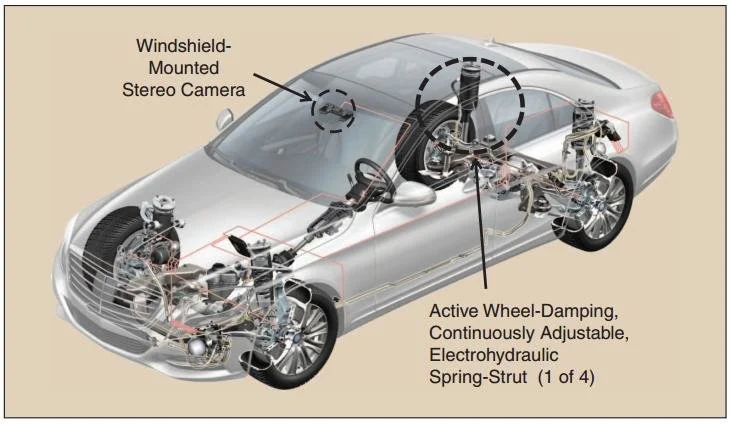
Unlike conventional suspension systems that merely react to road imperfections after the wheels encounter them, Magic Body Control anticipates what’s ahead and prepares the suspension accordingly. This proactive approach fundamentally changes the driving experience, delivering an unprecedented level of ride comfort that seems to defy physics.
The technology behind the magic
Road surface scan
The heart of Magic Body Control lies in its ability to “see” the road ahead. Using a stereo camera system, Magic Body Control scans the road surface up to 15 meters ahead of the vehicle and can measure variations as small as 3 millimeters in the road surface. This forward-looking capability operates at speeds up to 130 km/h (approximately 80 mph), covering the vast majority of driving scenarios.
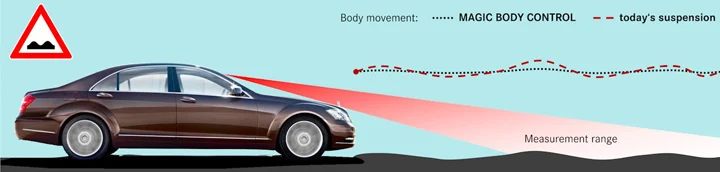
The stereo camera setup provides depth perception, allowing the system to accurately gauge the height and severity of upcoming bumps, potholes, and surface irregularities. This visual data is processed in real-time by the vehicle’s sophisticated computer systems, which then communicate with the suspension components.
Active hydraulic system
Once the Road Surface Scan detects imperfections, the magic truly begins. The Magic Body Control function adjusts the damping of each individual wheel to a firmer or softer setting in advance and increases or reduces the load on the wheel with the help of an active hydraulic system.
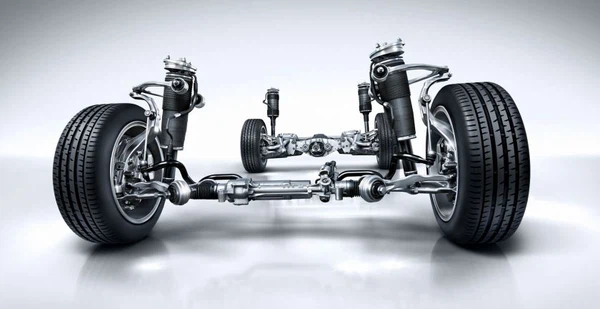
The system employs hydraulic actuators positioned at each wheel. These aren’t simple shock absorbers—they’re sophisticated, computer-controlled hydraulic cylinders that can actively push or pull on the suspension components. When the system detects a bump approaching the right front wheel, for example, it can stiffen that corner’s damping and pre-load the hydraulic actuator to counteract the upward force, effectively “lifting” the body before impact.
Dual-frequency management
One of the most impressive technical achievements of Magic Body Control is its ability to manage multiple frequencies of movement simultaneously. Through sophisticated hydraulics, the system manages two frequencies of movement—one at the wheels (between 15-20 Hz) and one at the body (5-8 Hz). This dual-frequency approach means the wheels can follow the road contours while the body remains remarkably stable, isolating passengers from road imperfections.
How it works in real-world driving
The operation of Magic Body Control is seamless and continuous. Here’s what happens in a fraction of a second:
- Scanning Phase: As you drive, the stereo cameras constantly monitor the road surface ahead, creating a detailed three-dimensional map of the road texture.
- Analysis Phase: The system’s computer analyzes this data, identifying bumps, dips, potholes, and other irregularities that could affect ride quality.
- Preparation Phase: The system presets the suspension to match any bumps or holes coming up, with each separate strut adjusting to apply the right amount of force to counteract the impending disturbance.
- Execution Phase: When the wheel actually encounters the road imperfection, the pre-adjusted suspension is already optimally configured, dramatically reducing the impact transmitted to the cabin.
This entire process happens continuously and automatically, requiring no driver input. The system works in conjunction with Mercedes-Benz’s Intelligent Drive suite, ensuring seamless integration with other vehicle systems.
Active curve tilting: taking it further
In 2014, the C217 S-Class Coupe introduced an update to Magic Body Control called Active Curve Tilting, which allows the vehicle to lean up to 2.5 degrees into a turn, similar to a tilting train. This innovative feature counters the effect of centrifugal force on occupants during cornering, making lateral acceleration feel less pronounced and significantly enhancing comfort during spirited driving or highway cruising.
When you enter a curve, the system tilts the entire vehicle body toward the inside of the turn, much like a motorcycle or a banking airplane. This reduces the sensation of being pushed to the outside of the turn, creating a more comfortable and confidence-inspiring experience for passengers.
Evolution to E-Active Body Control
Mercedes-Benz continued to refine this technology, leading to the development of E-Active Body Control. E-Active Body Control is an optional suspension system that includes Road Surface Scan, Airmatic, and Magic Body Control suspension, operating on a 48-volt electrical system.
Compared to the previous Magic Body Control, the use of 48-volt architecture accounts for a reduction by half of the energy needed for operation. This makes the system more efficient while maintaining the same impressive performance characteristics. The E-Active Body Control system also introduced new capabilities, including a “bounce” mode that can help free the vehicle if it becomes stuck in sand or snow.
Which Mercedes-Benz models feature Magic Body Control?
Magic Body Control has been an exclusive feature reserved for Mercedes-Benz’s flagship luxury vehicles:
Original Magic Body Control (2013-2020)
- Mercedes-Benz S-Class (W222): Magic Body Control was initially exclusive to the S-Class, including standard and long-wheelbase variants
- Mercedes-Benz S-Class Coupe (C217): Featured Magic Body Control with Active Curve Tilting
- Mercedes-Maybach S-Class: Available as standard or optional equipment depending on the model year and variant
- Mercedes-AMG S-Class models: The S65 AMG featured AMG calibration of the Magic Body Control suspension to deliver a mix of responsive cornering, comfort, and control
E-Active Body Control era (2018-present)
- Mercedes-Benz GLE-Class (V167): Initially offered as an option on six-cylinder and V8 models, though it was later discontinued for the GLE
- Mercedes-Benz GLS-Class (X167): Available on V8-equipped models including the GLS 580, and standard on the Mercedes-Maybach GLS 600
- Mercedes-Benz S-Class (W223): Current generation featuring the evolved E-Active Body Control system
- Mercedes-Maybach S-Class (current generation): Features E-Active Body Control as an available option, with a special Maybach driving mode that enhances riding comfort even further
- Mercedes-Maybach GLS 600: E-Active Body Control comes standard on this ultra-luxury SUV
It’s worth noting that Magic Body Control and E-Active Body Control have generally been reserved for higher trim levels and are often optional even on eligible models, making them relatively rare features that command premium pricing.
What are the benefits?
Unparalleled ride comfort
The primary benefit of Magic Body Control is the extraordinary ride quality it delivers. By anticipating and counteracting road imperfections before they affect the cabin, the system provides a level of comfort that traditional suspension systems simply cannot match. Passengers experience minimal vertical movement, even over severely damaged roads.
Reduced driver fatigue
Smoother rides aren’t just about luxury—they reduce driver fatigue on long journeys. When the body doesn’t constantly work to stabilize itself against bumps and jolts, occupants arrive at their destination feeling more refreshed.
Enhanced safety
A stable vehicle platform improves handling predictability and tire contact with the road surface. Magic Body Control helps maintain optimal tire grip even over uneven surfaces, contributing to better braking and cornering performance.
Protection of vehicle components
By minimizing harsh impacts, Magic Body Control reduces stress on other vehicle components, potentially extending the life of interior trim, electronic components, and structural elements.
Prestige factor
There’s an undeniable “wow” factor to demonstrating Magic Body Control’s capabilities. The famous wine glass demonstrations became iconic for a reason—they showcase technology that genuinely impresses even the most jaded automotive enthusiasts.
The challenges and considerations
Complexity and cost
Magic Body Control represents cutting-edge engineering, and that sophistication comes at a price. The system typically adds several thousand dollars to a vehicle’s purchase price. E-Active Body Control can cost approximately $6,500 as an option, making it a significant investment even for luxury car buyers.
Maintenance and repair
The hydraulic components, sensors, and computer systems that make Magic Body Control work are complex and can be expensive to maintain or repair. The system requires specialized knowledge and equipment for service, meaning repairs should be performed at authorized Mercedes-Benz service centers.
Weight
The hydraulic actuators, plumbing, and additional sensors add weight to the vehicle. While Mercedes-Benz engineers have worked to minimize this impact, it’s an inevitable trade-off for the system’s capabilities.
Limited availability
Because Magic Body Control has been reserved for top-tier Mercedes-Benz models, relatively few vehicles on the road actually feature it. This exclusivity maintains its prestige but also means fewer technicians are familiar with servicing the system.
Comparing Magic Body Control to competitors
Mercedes-Benz wasn’t the first to develop predictive suspension technology, but Magic Body Control represents one of the most sophisticated implementations. Competitors have developed their own systems:
- Audi’s Predictive Active Suspension: Uses camera data similarly to predict road conditions
- BMW’s Active Suspension: Offers impressive body control but generally without the predictive element
- Tesla’s Adaptive Air Suspension: Learns road imperfections via GPS and crowdsourced data
What sets Magic Body Control apart is its real-time predictive capability combined with the powerful hydraulic system that can actively push and pull on each corner of the vehicle. The combination of stereo camera scanning, sophisticated software, and robust hydraulics creates a system that remains at the forefront of suspension technology.
Real-world owner experiences
Owners of vehicles equipped with Magic Body Control consistently praise its effectiveness. Common themes in reviews include:
- The ability to glide over speed bumps and potholes that would jostle occupants in other vehicles
- Improved comfort on long highway drives, especially on aging road surfaces
- The impressive party trick of demonstrating the system to friends and family
- The feeling that rough roads have been “magically” smoothed out
However, some owners note that the system works best on clearly visible road imperfections. In certain conditions—such as driving into low-angle sunlight that affects camera visibility, or on wet roads where reflections might confuse the system—Magic Body Control may not perform as optimally as it does in ideal conditions.
The future of predictive suspension
Magic Body Control represents a significant milestone in automotive suspension technology, but it’s not the final word. Future developments may include:
- Integration with GPS and cloud-based mapping to “remember” road conditions on frequently traveled routes
- Enhanced camera systems with better night vision and adverse weather capability
- Even faster response times through improved computing power
- Potential integration with autonomous driving systems for optimized comfort
- Lighter-weight components through advanced materials
Mercedes-Benz’s ongoing development of E-Active Body Control shows the company’s commitment to advancing this technology. As electric vehicles become more prevalent, the availability of high-voltage electrical systems may make such sophisticated active suspension systems more common across a broader range of vehicles.
For those fortunate enough to experience it, Magic Body Control delivers on its promise of exceptional ride comfort. It made the S-Class the world’s first car to use Road Surface Scan to detect road bumps, setting a new benchmark for luxury vehicle suspension systems.
Leave a Reply
You must be logged in to post a comment.