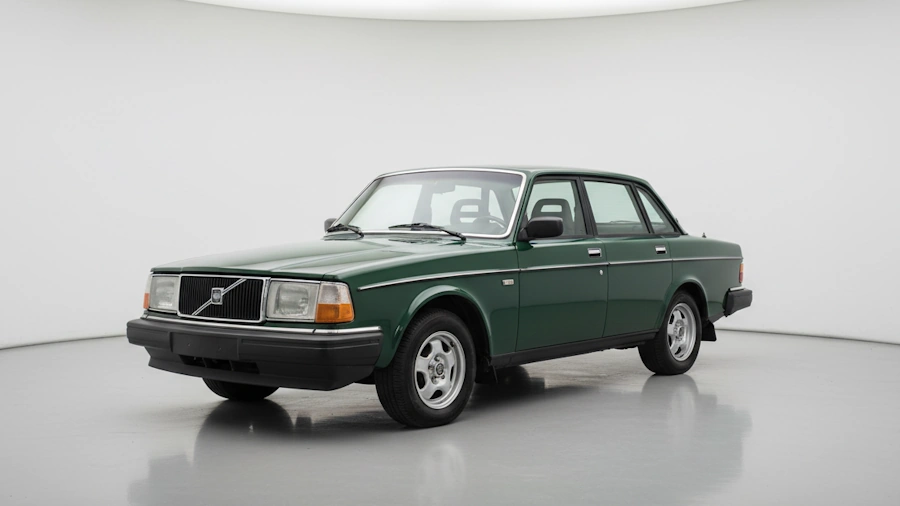
General information & model overview
| Category | Specification Details |
|---|---|
| Production Years | 1975 – 1990 (The entire 200 series continued until 1993) |
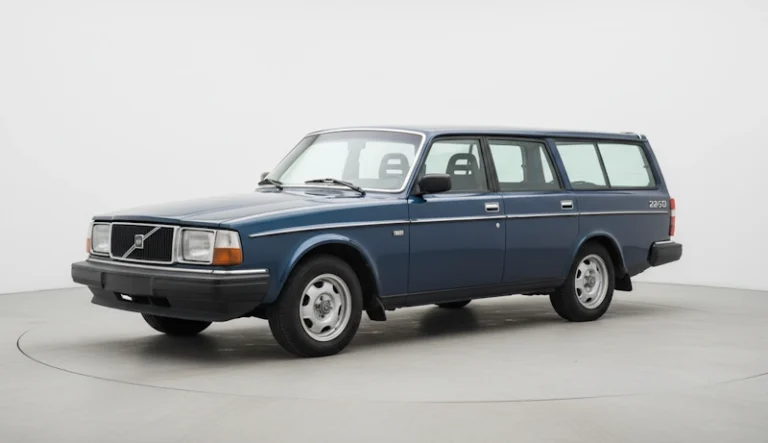
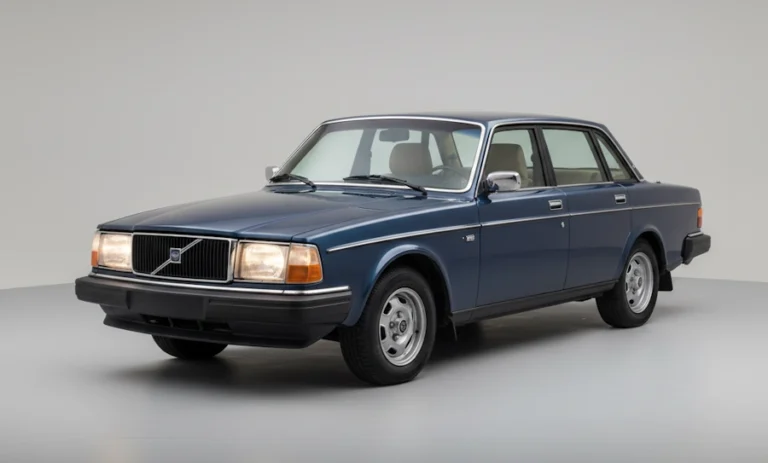
| Body Style | 4-door, 5-passenger sedan (saloon) |
| Designer | Jan Wilsgaard |
| Assembly | Gothenburg, Sweden (Torslanda); Ghent, Belgium; Halifax, Canada; Melbourne, Australia |
| Layout | Front-engine, rear-wheel-drive (FR layout) |
| Key Characteristics | Boxy design, industry-leading safety features, legendary reliability, simple and robust mechanicals. Known as the “Brick” for its shape and durability. |
Body & Dimensions
| Specification | Details |
|---|---|
| Wheelbase | 2,640 mm (104 in) |
| Length | 1975-1980: 4,890 mm (192.5 in) with large bumpers; 1981-1990: 4,790 mm (188.6 in) with slimmer bumpers |
| Width | 1,710 mm (67.3 in) |
| Height | 1,430 mm (56.3 in) |
| Curb Weight | Approx. 1,290 – 1,410 kg (2,844 – 3,109 lbs) depending on engine, transmission, and options |
| Turning Circle | 9.8 m (32.2 ft) – Exceptionally tight for its size |
| Fuel Capacity | 60 liters (15.8 US gallons) |
Engine Specifications (Common Variants)
| Engine Code | Type | Displacement | Fuel System | Power Output (approx.) | Torque (approx.) | Notes |
|---|---|---|---|---|---|---|
| B20A | 4-cyl SOHC 8v | 1986 cc | Carburetor | 82 hp @ 4800 rpm | 147 Nm (108 lb-ft) | Early base model, carryover from 140 series |
| B21A | 4-cyl SOHC 8v | 2127 cc | Carburetor | 100 hp @ 5000 rpm | 170 Nm (125 lb-ft) | Common base engine in Europe (DL) |
| B21E | 4-cyl SOHC 8v | 2127 cc | Bosch K-Jetronic | 123 hp @ 5250 rpm | 170 Nm (125 lb-ft) | Higher compression, performance-oriented (GL) |
| B21F | 4-cyl SOHC 8v | 2127 cc | Bosch K-Jetronic | 107 hp @ 5250 rpm | 165 Nm (122 lb-ft) | US-market version of B21E with catalyst & Lambda sensor |
| B21ET | 4-cyl SOHC 8v Turbo | 2127 cc | Bosch K-Jetronic | 155 hp @ 5500 rpm | 240 Nm (177 lb-ft) | First Turbo model, mainly European market |
| B23E | 4-cyl SOHC 8v | 2316 cc | Bosch K-Jetronic | 136 hp @ 5500 rpm | 190 Nm (140 lb-ft) | High-performance NA engine (GLT) |
| B230F | 4-cyl SOHC 8v | 2316 cc | Bosch LH-Jetronic | 114 hp @ 5400 rpm | 185 Nm (136 lb-ft) | The ubiquitous “Redblock”. Standard in most markets post-1985 |
| B230FT | 4-cyl SOHC 8v Turbo | 2316 cc | Bosch LH-Jetronic | 162 hp @ 5300 rpm | 264 Nm (195 lb-ft) | Intercooled Turbo. Used in Turbo models post-1985 |
| D24 | 6-cyl SOHC 12v Diesel | 2383 cc | Mechanical Injection | 82 hp @ 4800 rpm | 140 Nm (103 lb-ft) | Volkswagen-sourced inline-6 diesel engine (slow but efficient) |
Drivetrain & Transmission
| Category | Details |
|---|---|
| Manual Transmissions | M45: 4-speed manual; M46: 4-speed manual with electronic Laycock de Normanville overdrive (operated via a button on the gear knob); M47: True 5-speed manual (introduced ~1983) |
| Automatic Transmissions | BW35/55: BorgWarner 3-speed automatic (early models); AW70: Aisin-Warner 4-speed automatic (non-overdrive lockup); AW71: Aisin-Warner 4-speed automatic (stronger version for Turbo models) |
| Final Drive Ratios | Varied significantly. Common ratios included 3.31:1, 3.54:1, 3.73:1, and 4.10:1 depending on engine, transmission, and market. |
Chassis, Suspension & Brakes
| Component | Specification |
|---|---|
| Front Suspension | MacPherson strut with coil springs and lower control arm. Anti-roll bar standard on most models. |
| Rear Suspension | Live axle located by four trailing arms and a Panhard rod, with coil springs and separate shock absorbers. |
| Steering | Rack and pinion. Power assistance was optional on early base models, later becoming standard across the range. |
| Brake System | 4-wheel power-assisted disc brakes standard on all models. Unique dual-circuit, triangle-split hydraulic system. If one circuit fails, 80% of braking power is retained on both front wheels and one rear wheel. Ventilated front discs on Turbo and some GLT models. ABS (Anti-lock Braking System) became optional on high-end models from the mid-1980s. |
| Wheels & Tires | Standard: 14×5.5-inch steel wheels with 185/70 R14 tires. Optional/High Trim: 15-inch alloy wheels, most famously the “Virgo” (Turbo) and “Scorpius” designs, with 195/60 R15 tires. |
Performance (Approximate Figures)
| Metric | Performance Data |
|---|---|
| 0-100 km/h (0-62 mph) | 244 DL (B21A): ~13.5 seconds; 244 GL (B230F): ~11.5 seconds; 244 Turbo (B21ET/B230FT): ~8.5 – 9.0 seconds |
| Top Speed | 244 DL (B21A): ~160 km/h (100 mph); 244 GL (B230F): ~175 km/h (109 mph); 244 Turbo (B230FT): ~200 km/h (125 mph) |
Key Model Year Changes & Facelifts
| Year | Changes |
|---|---|
| 1975 | Launch model. Features carryover B20 engine and new B21. Large, protruding bumpers to meet US safety standards. |
| 1978 | First minor facelift. “Coffin” style recessed grille replaced with a flush, single-piece design. Rear tail lights wrap around the side of the body. |
| 1980 | Round headlights replaced with square/rectangular units on most models (US models retained quad-sealed beams). Introduction of the D24 diesel engine. |
| 1981 | First major facelift. New, flatter hood and fenders. New grille design. Slimmer plastic bumpers introduced. All-new dashboard and interior. |
| 1983 | B23/B230 engine family introduced, offering more displacement and power. M47 5-speed manual transmission becomes available. |
| 1986 | Second major facelift. Smoother, more integrated front-end with a less pronounced “hood bulge”. US models get one-piece composite headlights. Upgraded interior trim and revised rear badging. |
| 1990 | Final year for the 244 model designation. Features include driver’s side airbag (standard in US, optional elsewhere) and ABS becoming more widely available. The model line is simplified in anticipation of its replacement by the 940. |
Trim Levels Explained
| Trim Level | Description |
|---|---|
| DL (De Luxe) | Base model. Typically featured a carbureted engine (e.g., B21A), basic cloth or vinyl interior, manual windows, and steel wheels. |
| GL (Grand Luxe) | Mid-range comfort model. Usually came with a fuel-injected engine (e.g., B21F/B230F), velour upholstery, power steering, and better sound insulation. |
| GLE (Grand Luxe Executive) | Luxury-oriented trim. Added features like leather seats, power windows and mirrors, sunroof, cruise control, and often alloy wheels. |
| GLT (Grand Luxe Touring) | The sporty, naturally-aspirated model. Featured a more powerful engine (e.g., B23E), stiffer suspension, blacked-out trim instead of chrome, alloy wheels, and a front air dam. |
| Turbo | Top performance model. Equipped with the turbocharged engine (B21ET/B230FT), GLT suspension and appearance package, plus a turbo boost gauge in the instrument cluster. |
Pioneering Safety Features (A Volvo Hallmark)
| Safety Feature | Details |
|---|---|
| Structural Integrity | Extremely rigid passenger safety cell with energy-absorbing crumple zones at the front and rear. Steel side-impact protection beams in doors. Reinforced roof structure. |
| Restraint Systems | 3-point seatbelts for all outboard passengers (front and rear) from launch. Driver’s side airbag became standard in the US in 1990. |
| Braking System | The fail-safe triangle-split dual-circuit brake system was a significant advancement, ensuring braking capability even with a partial system failure. |
| Visibility & Ergonomics | Large greenhouse with thin pillars for excellent visibility. Ergonomically designed controls and seats to reduce driver fatigue. Head restraints designed to prevent whiplash. |
| Other Features | Collapsible steering column, recessed door handles, and a fuel tank located in a protected position ahead of the rear axle. |
Story of Volvo 244 (1975–1990): engineering endurance and timeless appeal
Few cars have captured the loyalty of enthusiasts, the trust of families, and a reputation for durability quite like the Volvo 244. Launched in August 1974 as part of the 240 Series, the 244 sedan quickly established itself as the backbone of Volvo’s range, becoming a global icon during its 15-year run and helping to cement the company’s reputation for safety and dependability.
Roots and development
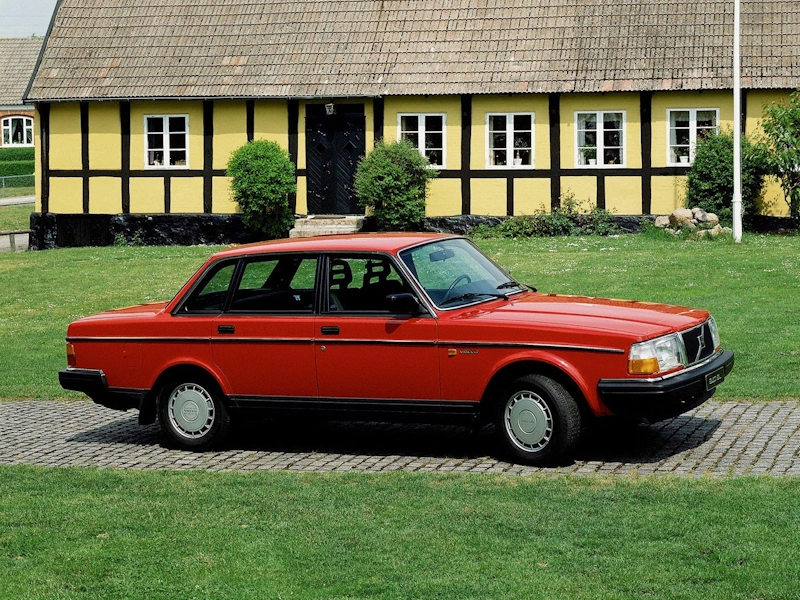
The Volvo 244 evolved from the earlier 140 Series but brought a host of advancements. Most notably, it introduced an all-new front design, robust bumpers, and a revised chassis featuring McPherson front suspension, further enhancing ride comfort and safety.
When launched, the 244 offered a choice of advanced overhead-cam engines and, for a time, even a V6 and an innovative 6-cylinder diesel—the first of its kind in a European passenger car.
Legendary safety: designed to survive
Safety wasn’t just a marketing slogan for the 244—it was its mission. Volvo subjected its new series to some of the world’s toughest crash tests and made the 244 a reference point for US safety development. Features pioneered included the robust “safety cage” passenger compartment, collapsible steering columns, triangle-split braking systems, and, in later years, available ABS and even a driver airbag in US models from 1990.
User experience: what it’s like to drive and own
Owners cherish the 244 for both its reliability and its honest, no-nonsense driving experience. With its signature boxy design, the 244 offers outstanding visibility—a boon for city driving and long hauls alike. Its seating is renowned for comfort on even the longest trips, while a simple, functional dashboard keeps distractions at bay. The car’s solid engineering means well-maintained examples routinely reach 300,000 km (186,000 mi) or more.
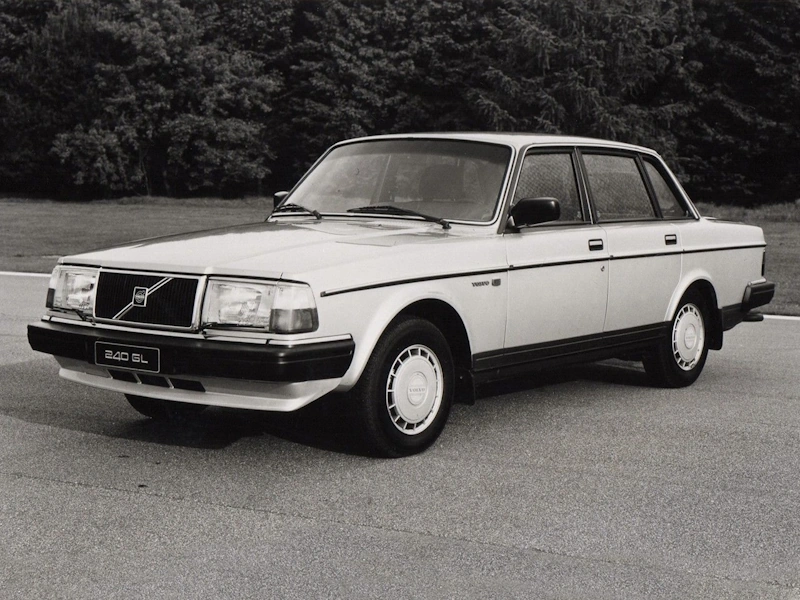
Despite modest power (engines ranged from around 82 to 155+ hp, depending on year and spec), acceleration is reassuring rather than sporty. Manuals and automatics were both available, making the 244 an easy companion for a variety of drivers. The cargo space is generous, and the car’s build quality feels almost tank-like. Road noise is moderate, refinement good for its era, and the 244’s smooth ride over rough roads is legendary.
Market success and global reach
During nearly two decades in production, more than 1.48 million Volvo 244 sedans were sold, with assembly taking place on several continents. Its ruggedness meant the car suited Scandinavian winters, Australian heat, and American freeways equally well. The 244 was popular among everyone—from European taxi fleets to suburban US families. In fact, in Sweden, the Volvo 240/244 became so enduring that sightings are common even today, more than 30 years after its retirement.
Key facelifts and evolution
The 244 saw two primary facelifts—first in 1981, bringing updated headlights and trim, and again in 1986 with subtle styling and comfort upgrades.
Throughout its life, Volvo continually improved emissions, safety, and mechanical refinement. Notable was the introduction of powerful turbocharged versions, starting in the 1980s, and (for select markets) advanced injection and diesel engines.
Ownership: strengths and things to watch
- Durability: With reports of some examples running well past 500,000 km, the 244 is a byword for longevity. Major mechanical and body components were over-engineered, and parts remain available worldwide.
- Safety: The car remains a shining example of Volvo’s safety-first design philosophy.
- Maintainability: Unlike many rivals, the 244 features an easy-access engine bay and robust, simple mechanicals, making it beloved by home mechanics and restoration enthusiasts.
- Classic appeal: The geometric, “boxy” silhouette is now classic 1970s-80s style, beloved by car collectors and retro fans alike.
- Modern drawbacks: Fuel economy is fair but not class-leading by modern standards. Some trims lack air-conditioning, and power steering was not universal on early versions. Rust can be an issue on neglected cars, so inspection is vital before buying.
The legacy of the Volvo 244
Simply put, the Volvo 244’s influence continues: it’s a common choice for those seeking a usable, affordable classic that’s safe, practical, and mechanically straightforward. Its history includes both humble family transport and motorsport (thanks to the formidable 240 Turbo in Group A racing). The 244’s enduring presence on roads around the world is testimony enough.
Conclusion: more than just a car
For families, students, collectors, and commuters, the Volvo 244 offers a unique combination of durability, safety, and timeless design. It’s a Swedish classic, not just for enthusiasts, but for anyone who appreciates dependable, honest engineering.
Leave a Reply
You must be logged in to post a comment.