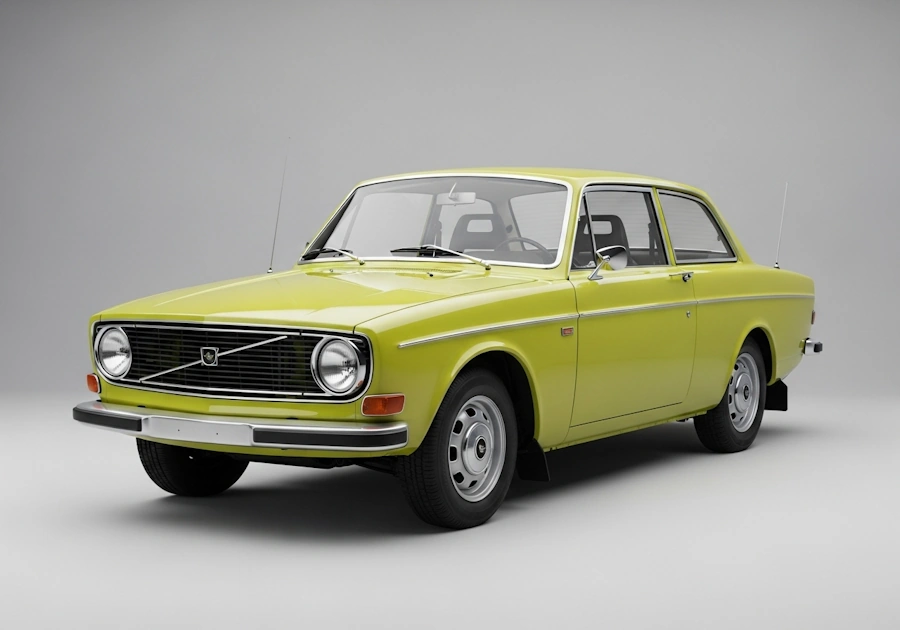
The Volvo 142 debuted in 1967 as a more affordable, lighter two-door alternative to the four-door 144, sharing the same platform but with fewer side windows and easier rear access via fold-forward front seats. It marked Volvo’s shift to a modern, rectilinear design, replacing the curvier Amazon series. Over its run, it received updates like larger engines in 1969, fuel injection in 1971, and safety enhancements in 1973–1974. Trim levels evolved from basic to “S” (sport) and later “GL” (Grand Luxe) with premium features.
| Category | Subcategory | Details |
|---|---|---|
| General | Model | Volvo 142 |
| Body Style | 2-door sedan (saloon/coupe) | |
| Production Years | 1967–1974 | |
| Production Volume | 412,986 units | |
| Assembly Location | Torslandaverken, Sweden | |
| Layout | Front-engine, rear-wheel drive (FR) | |
| Engine | Type | Inline-4, overhead valves |
| Displacements | 1,778 cc (1.8L) or 1,986 cc (2.0L) | |
| Bore x Stroke | 84.14 x 80 mm (1.8L); 88.9 x 80 mm (2.0L) | |
| Variants | B18A/B18B (carbureted, 1.8L); B20A/B20B (carbureted, 2.0L); B20E (fuel-injected high-compression, 2.0L, 124–130 hp); B20F (fuel-injected low-compression, 2.0L, 109 hp US) | |
| Power Outputs | 90 hp (66 kW) @ 4800 rpm; 118 hp (87 kW) @ 5800 rpm; 135 hp (99 kW) @ 6000 rpm (variant-dependent) | |
| Torque Outputs | 120 lb-ft (163 Nm) @ 3000 rpm; 123 lb-ft (167 Nm) @ 3500 rpm; 130 lb-ft (176 Nm) @ 3500 rpm | |
| Fuel System | Carburetor (Stromberg or similar); Bosch D-Jetronic/K-Jetronic fuel injection (later models) | |
| Fuel Type | Gasoline | |
| Transmission | Options | 4-speed manual; 4-speed manual + overdrive; 3-speed automatic |
| Selector | Column-mounted (early automatic); Floor-mounted T-bar (from 1971–1972) | |
| Performance | Modest; specific 0–60 mph times not standardized but aligned with power levels | |
| Performance | Top Speed | 92 mph (148 km/h) for 90 hp; 101 mph (163 km/h) for 118 hp; 109 mph (175 km/h) for 135 hp |
| Acceleration | Modest; specific 0–60 mph times not standardized but aligned with power levels | |
| Chassis & Suspension | Front | Independent with coil springs and wishbones |
| Rear | Live axle with coil springs | |
| Brakes | System | Hydraulic disc brakes on all four wheels |
| Tires | 165 SR 15 | |
| Dimensions | Length | 182–183.1 in (464–465 cm) |
| Width | 68.1 in (173 cm) | |
| Height | 56.7 in (144 cm) | |
| Wheelbase | 102.5–103.1 in (260–262 cm) | |
| Track (Front/Rear) | 53.1 in (135 cm) | |
| Ground Clearance | 7.1 in (18 cm) | |
| Curb Weight | 2,491–2,601 lbs (1,130–1,180 kg) | |
| Safety Features | Brakes | All-four-wheel discs |
| Seatbelts | Retractable mounting points (from 1972) | |
| Dashboard | Padded and redesigned (1973) | |
| Fuel Tank | Axle-positioned for protection (1974) | |
| Bumpers | Larger, protruding (1974) | |
| Other | Electric rear defrost (1970); Flow-through ventilation (1970); No quarter-lights (1974) | |
| Interior Features | Dashboard | Straight with full gauges (tach, speedo, fuel, temp, oil, voltage) and warning lights |
| Updates | Fake woodgrain (1972); Rocker switches and air vents (1973) | |
| Exterior Features | Styling | Boxy with minimalist lines; Updates: Black grille (1971), Flush handles (1972), Plastic grille/larger indicators (1973) |
| Windows | Two side windows; Removed quarter-lights (1974) | |
| Trim Levels | Early | Standard, S (sport) |
| Later | L (luxe), de Luxe, GL (Grand Luxe with overdrive standard) | |
| Model Updates | 1967–1968 | B18 engines; Basic trim |
| 1969 | B20 engine and alternator | |
| 1970 | Ventilation and defrost improvements | |
| 1971 | Fuel injection (B20E); Grille/wheel changes | |
| 1972 | Flush handles; Dashboard revisions; B20F for emissions | |
| 1973 | Major facelift (grille, indicators, tail); Trim to L/de Luxe/GL; Padded dash | |
| 1974 | K-Jetronic; Safety enhancements (tank, bumpers) |
Engine variants comparison table
| Variant | Displacement | Power | Torque | Fuel System | Top Speed | Weight |
|---|---|---|---|---|---|---|
| 2.0L (90 hp) | 1,986 cm³ | 90 hp (66 kW) @ 4800 rpm | 120 lb-ft (163 Nm) @ 3000 rpm | Carburetor | 92 mph (148 km/h) | 2,491 lbs (1,130 kg) |
| 2.0L (118 hp) | 1,986 cm³ | 118 hp (87 kW) @ 5800 rpm | 123 lb-ft (167 Nm) @ 3500 rpm | Carburetor | 101 mph (163 km/h) | 2,535 lbs (1,150 kg) |
| 2.0L (135 hp) | 1,986 cm³ | 135 hp (99 kW) @ 6000 rpm | 130 lb-ft (176 Nm) @ 3500 rpm | Monopoint Injection | 109 mph (175 km/h) | 2,601 lbs (1,180 kg) |
| B20F (US Emissions) | 1,986 cm³ | 109 hp (81 kW) @ 6000 rpm | Varies | K-Jetronic (1974) | ~100 mph (est.) | 2,580–2,898 lbs (1,170–1,315 kg) |
Production and market
| Year | Key Changes | Production Notes | Market-Specific |
|---|---|---|---|
| 1967 | Introduction with B18 engines | ~1,500 units (limited start) | Standard/S trims; Europe focus |
| 1968 | Full production ramp-up | Shared with 145 wagon intro | Carbureted options |
| 1969 | B20 engine upgrade | Alternator added | Global availability |
| 1970 | Ventilation enhancements | Electric defrost | Export growth |
| 1971 | B20E fuel injection | Styling tweaks (grille, wheels) | Automatic floor shift |
| 1972 | B20F for emissions; Dashboard updates | Flush handles | US market detuning |
| 1973 | Major facelift; Trim restructuring | Padded dash; GL intro | North Korea export (related 144) |
| 1974 | Safety/fuel system updates | End of production | Transition to 240 series |
The Volvo 142, produced from 1967 to 1974, represents a cornerstone in automotive history as part of Volvo’s groundbreaking 140 series. This two-door sedan, often overshadowed by its four-door sibling the 144 or the wagon 145, embodied Volvo’s shift toward modern, safety-focused design while maintaining the brand’s reputation for reliability and practicality.
With over 412,986 units built primarily at Volvo’s Torslandaverken plant in Sweden, the 142 appealed to families and professionals seeking a sturdy, no-nonsense vehicle. Today, it holds appeal for collectors and enthusiasts who value its mechanical simplicity, sustainability through longevity, and a driving experience that evokes mindfulness in an era of digital distractions.
Historical development and production
The 142’s story begins in the mid-1960s as Volvo sought to replace the curvaceous Amazon (120 series) with a more angular, functional lineup. Launched in the summer of 1967—shortly after the 144—the 142 was positioned as a lighter (about 40 kg or 88 lbs less), slightly more affordable two-door alternative, priced lower to attract budget-conscious buyers. It shared the same technical foundation, including engines and chassis, but featured distinct bodywork with longer doors for better rear access and only two side windows, contrasting the 144’s three. The series as a whole won the 1966 Car of the Year from Swedish magazine Teknikens Värld for its innovations.
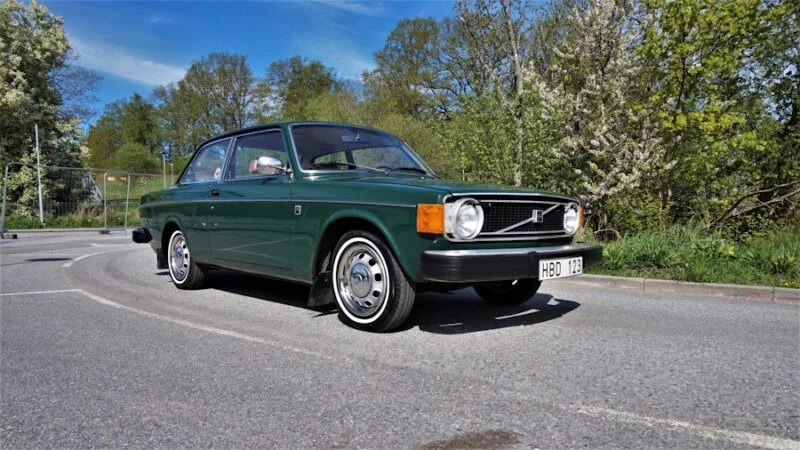
Production ramped up from a limited 1,500 units in 1967, contributing to the 140 series’ total of over 1.25 million vehicles.
Key milestones included the 1969 switch to the larger B20 engine with an alternator, 1970 ventilation and defrost improvements, 1971 fuel injection and styling tweaks (black grille, new wheels), 1972 flush door handles and emissions-tuned B20F, and 1973-1974 facelifts with plastic grilles, larger indicators, padded dashboards, protected fuel tanks, and bigger bumpers. Trim levels evolved from base and S (sport) to L (luxe), de Luxe, and GL (Grand Luxe) with luxuries like overdrive.
The 142 played a role in Volvo’s international expansion, including quirky exports like 1,000 related 144s to North Korea in 1973 (unpaid, creating a lingering debt). By 1974, it transitioned to the refined 240 series, but its design philosophy endured, influencing Volvo’s “boxy but safe” ethos.
Design philosophy and features
Volvo’s chief designer Jan Wilsgaard crafted the 142 with a stark, rectilinear “3-box” aesthetic, prioritizing space, safety, and functionality over flair—a quantum leap from the Amazon’s curves.
Dimensions included a 464-465 cm length, 173 cm width, 144 cm height, and 260 cm wheelbase, with curb weights of 1,130-1,180 kg. The interior was minimalist yet spacious, with full analogue gauges (tachometer, speedometer, fuel, temperature, oil pressure, voltage), warning lights, and manual controls.
Updates brought fake woodgrain trim, rocker switches, improved vents, and electric rear defrost.
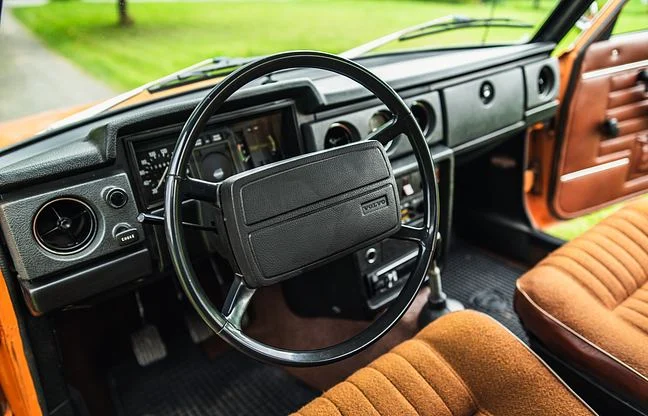
Safety was revolutionary: all-disc brakes (a first for many), dual-circuit system, crumple zones, integrated roll cage, breakaway steering column, accident-proof door locks, three-point belts (rear retractable from 1972), and padded dashboards (1973).
The 1974 model added axle-positioned fuel tanks for rear-impact protection and removed quarter-lights for better ventilation. Suspension featured independent front coils with wishbones and a rear live axle on coils, paired with 165 SR 15 tires for balanced comfort and handling.
Engines, transmission, and performance
Early 142s used the 1.8L B18 inline-four (75-100 hp with carburetors), upgraded in 1969 to the 2.0L B20 (82-124 hp base, up to 135 hp in tuned variants). Fuel-injected B20E (1971) and low-compression B20F (US emissions) offered smoother power, with Bosch D-Jetronic or K-Jetronic systems.
Transmissions included 4-speed manuals (with optional overdrive), or 3-speed automatics (column-shift early, floor T-bar later). Rear-wheel drive ensured predictable handling.
Performance was adequate for the era: 90 hp models topped 92 mph, 118 hp at 101 mph, and 135 hp at 109 mph, with modest acceleration emphasizing safety over speed. Factory R-Sport kits could boost to 190 hp with 2.2L displacement.
| Engine Variant | Displacement | Power (hp) | Torque (Nm) | Fuel System | Top Speed (mph) |
|---|---|---|---|---|---|
| B18A/B (Early) | 1.8L | 75-100 | 163-167 | Carburetor | 92-101 |
| B20A/B | 2.0L | 82-118 | 163-167 | Carburetor | 92-101 |
| B20E (Injected) | 2.0L | 124-135 | 176 | D-Jetronic | 109 |
| B20F (US) | 2.0L | 109 | Varies | K-Jetronic | ~100 |
Driving experience and user perspectives
Owners describe the 142 as a “mindful” drive: analogue gauges, physical steering effort, smooth long-throw shifter, and earlier braking create a serene, engaging feel without modern beeps or assists. It’s plucky and fun on country roads, with good torque from D-Jet models, but pants on hills and rolls in curves with whistling tires.
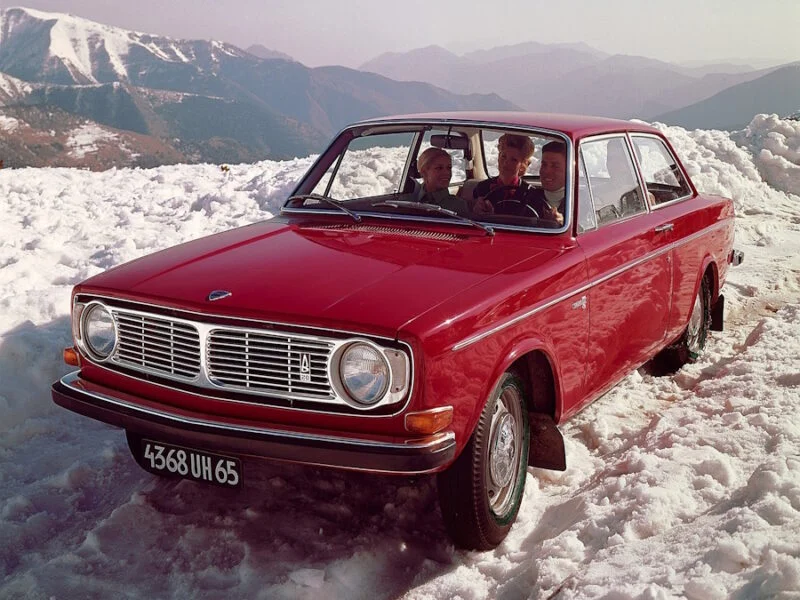
Comfort shines with spacious, bouncy seats and a compliant ride, even lowered. Forums like Turbobricks highlight its daily-driver potential in mild climates, with one owner clocking 108,000 miles on a ’72 144. Recent X posts show enthusiasts sharing rally photos and nostalgic ads, underscoring its enduring charm.
A 2024 review praises its unhurried pace for sustainability—lasting decades reduces new-car production. Project cars, like a 1969 142, achieve 28 mpg post-rebuild and handle autocross well.
Reliability and common issues
The 142 is “dumb but reliable” if maintained, with engines lasting 250,000+ km.
- Rust is the biggest foe, affecting sills, wheel arches, floors, and chassis—check with magnets for hidden filler.
- D-Jetronic issues include clogged injectors, faulty sensors, and harness cracks; carbs need tuning.
- Other problems: oil leaks/consumption, transmission noises, brake booster leaks, suspension play, cooling leaks (especially B30), and electrical grounds. Winters accelerate rust; use premium gas and ZDDP additives.
| Common Issue | Symptoms | Fixes |
|---|---|---|
| Rust | Bubbles, holes in body/chassis | Welding, rustproofing; check sills/arches |
| D-Jetronic | Rough idle, petrol smell | Clean injectors, replace sensors/harness |
| Oil Burning | Blue smoke, low levels | Valve seals, rings; compression test |
| Brakes | Pulling, sinking pedal | Rebuild calipers/booster; bleed properly |
| Suspension | Uneven wear, play | Bushings, ball joints, alignment |
Restoration and buying guide
Restoration starts with brakes, fuel/ignition, and rust assessment—e.g., one owner rebuilt brakes and carbs first. Challenges include sourcing D-Jet parts or boosters; convert to electronic ignition.
Costs vary—brake jobs $800+ in parts; use polyurethane bushings, powdercoat wheels.
Tips: Inspect VIN/service history, test drive for smoke/dips, prioritize rust-free bodies.
Collector values:
- $750–$10,000 based on condition;
- Hagerty’s 1 Concours at $9,500 (2025).
Buy from mild climates; avoid salty-road examples.
Legacy and modern appeal
The 142’s safety innovations and durability influenced Volvo’s lineup, with the 240 as its direct successor.
Today, it’s a sustainable choice—lasting vehicles reduce environmental impact. Enthusiasts on X and forums celebrate its patina and modifiability, from rally builds to daily drivers. While not commanding high resale like Alfas, its understated style endures.
Key takeaways on the Volvo 142 (1967-1974)
- The Volvo 142 stands out as a pioneering two-door sedan in the 140 series, emphasizing safety and durability, with over 412,000 units produced; it helped establish Volvo’s global reputation for reliable family cars.
- Evidence leans toward strong reliability for well-maintained examples, making it suitable as a daily driver in mild climates, though owners note it requires regular upkeep to combat rust and mechanical wear.
- Collector values typically range from $1,000–$2,500 for fixer-uppers to $8,000–$10,000+ for excellent condition cars, with Hagerty estimating $9,500 for a top concours 1974 model, reflecting growing appreciation among enthusiasts.
- Research suggests a balanced view: praised for its analogue driving fun, comfort, and sustainability through longevity, but critiqued for modest performance and vulnerability to corrosion, appealing to those valuing mechanical simplicity over modern conveniences.
Leave a Reply
You must be logged in to post a comment.